links:
onion: http://drughuberjxfrxtlk2cystdz4jvogmc3lsnk5drvwx2nfi63ou2r2kid.onion/
www mirror: http://drughuberjxfrxtlk2cystdz4jvogmc3lsnk5drvwx2nfi63ou2r2kid.online
New official site: http://drughubgo.com
clearnet: https://drughub.io/
Inside DrugHub: How One Darknet Marketplace Is Redefining Security Through Mandatory Encryption
The darknet marketplace landscape has undergone significant upheaval in recent months. Archetyp, once considered a leading platform, disappeared. Abacus followed. Incognito burned its users. In this volatile environment, one marketplace has quietly positioned itself as the survivor: DrugHub.
What sets DrugHub apart isn’t flashy marketing or promises of anonymity—it’s a fundamentally different approach to security architecture. The platform, which has operated for approximately six years, enforces end-to-end encryption and passwordless authentication as non-negotiable requirements. For those familiar with darknet markets, this represents a departure from industry norms. For law enforcement, it presents unique challenges.
The Passwordless Paradigm
Most online platforms rely on usernames and passwords. DrugHub eliminates them entirely. Instead, users authenticate through PGP—Pretty Good Privacy, a cryptographic protocol that’s been around since 1991. To log in, users must possess their private encryption key and demonstrate ownership by digitally signing a challenge message.
“Passwordless login. No usernames or passwords to remember, all you need is access to your PGP key,” the platform’s documentation states. This effectively implements two-factor authentication by default, though the platform frames it as enforced PGP signatures.
The approach has practical implications. Database breaches, a common vector for compromising user accounts across the internet, become largely irrelevant when there are no passwords to steal. However, this security model comes with a steep learning curve. Users unfamiliar with PGP encryption—and many are—face a barrier to entry.
DrugHub’s administrators are unapologetic about this. “Do not contact staff asking us ‘how do I sign a message’, ‘how do I encrypt to multiple recipients’, ‘how do I verify a signature’,” reads one official communication to users. “You can find that information by using your favorite search engine or your favorite GPT model, staff won’t waste their time to copy paste the results to you.”
Enforced End-to-End Encryption
Where DrugHub’s security model becomes particularly interesting is in its handling of communications. The platform doesn’t just encourage encryption—it makes it impossible to communicate without it.
Traditional darknet markets often offer “auto-encryption” where the platform encrypts messages on behalf of users. This convenience comes with a critical vulnerability: the platform itself can read messages before encrypting them. If law enforcement seizes servers, they potentially gain access to unencrypted communications, shipping addresses, and transaction details.
DrugHub eliminates this possibility. All messages are encrypted client-side, using only the recipient’s public key. Unless a dispute is opened—in which case a staff key must be added to the encryption—no one except sender and recipient can decrypt communications.
“Unless an order is disputed, you only encrypt with vendor (or customer) key so nobody can read your messages,” the platform explains. “If servers get seized plaintext cannot be recovered.”
This created an interesting technical challenge for vendors handling hundreds of orders simultaneously. Manually encrypting and decrypting each message became a significant time burden. DrugHub’s solution was the Encryption Helper—a roughly 280-line Python script that functions as a reverse proxy on the vendor’s own machine.
The tool handles encryption and decryption transparently, importing customer keys into temporary keyrings to avoid cluttering the vendor’s main key storage. Notably, DrugHub also developed a Go language version but refuses to distribute pre-compiled binaries. Users must compile the code themselves—a decision clearly aimed at preventing the distribution of potentially compromised executables.
“You need to compile the code yourself as we would never provide or ask users to run binary code,” administrators stated in the release announcement.
The Invoice Model and Financial Architecture
DrugHub’s financial structure differs markedly from typical marketplace operations. Most darknet markets require users to deposit cryptocurrency into platform-controlled wallets before purchasing. These “hot wallets”—cryptocurrency wallets connected to the internet—represent tempting targets for both hackers and law enforcement.
DrugHub uses an invoice-based system instead. When a user places an order, the platform generates a payment invoice with a unique Monero (XMR) address. The user sends payment directly for that specific transaction. The marketplace wallet exists only for handling refunds, overpayments, and dispute resolutions.
Monero, a privacy-focused cryptocurrency that obscures transaction details through cryptographic techniques, is the platform’s exclusive currency. While some markets accept Bitcoin or other cryptocurrencies, DrugHub’s systems are designed around Monero’s privacy features.
Critically, the platform maintains no hot wallets on servers. Withdrawals are processed manually, offline, within 24 hours. If servers were seized, law enforcement would not find cryptocurrency ready for confiscation—a lesson learned from numerous previous marketplace takedowns.
The platform charges customers a transparent 5% commission fee. “Customer pays market commission,” administrators explain. “This is de facto on any market because vendors add market commission on top of their product price, we are just being open about it.”
Private Mirrors and DDoS Mitigation
Darknet marketplaces face constant distributed denial-of-service attacks from competitors, law enforcement, or extortionists. DrugHub’s response is what it calls an “innovative link distribution system” where each user receives unique .onion addresses—the special URLs used to access Tor hidden services.
Rather than sharing common mirror sites that can be targeted, vendors receive two private mirrors immediately upon approval. Customers can request private mirrors after meeting activity thresholds. According to forum discussions, users who have spent approximately $3,000-4,000 on the platform generally receive private mirrors when requested.
“Unlike regular mirror rotation everyone will get a truly unique mirror,” the platform states. “No DDoS, always up, always fast.”
When main public mirrors come under attack—which happens regularly—users with private mirrors can continue accessing the platform uninterrupted. However, DrugHub warns against sharing these private URLs. The mirrors are linked to specific accounts, and aggressive scraping detected on a private mirror results in account termination.
Rules and Prohibited Items
DrugHub maintains an extensive ruleset that provides insight into both operational security and attempts to limit law enforcement attention. The prohibited items list includes weapons (though body armor is permitted), fentanyl and its analogues, poisons, pornography, stolen data from law enforcement or government organizations, and stolen data from schools or hospitals.
Notably, all business with or information sales targeting the Russian Federation and Commonwealth of Independent States is explicitly forbidden. The platform provides no explanation for this geopolitical restriction.
Vendors face immediate consequences for circumventing the encryption requirements. Forum posts document cases where vendors were caught including sensitive information like tracking numbers in quick-reply templates—which are meant only for generic responses. At least one vendor was permanently banned after repeatedly placing a ProtonMail address in their vendor bio despite warnings.
“On 06/15 you placed your protonmail in your vendor bio, staff limited your account, you promised to read and follow market rules. Staff enabled your account. On 06/17 you placed your protonmail in your vendor bio, your account got banned,” an administrator wrote to one vendor. “Be grateful we allow your ‘customers’ to withdraw, you know what i’m sayin? Now fuck off.”
The User Experience and Practical Realities
The platform’s security-first approach has usability tradeoffs. Multiple users in forum discussions have complained about connectivity issues, with DrugHub administrators responding that if 99% of users can connect successfully, the problem lies with the user’s setup.
The platform implements proof-of-work challenges to mitigate DDoS attacks, requiring users to solve computational puzzles before accessing the site. “You need a decent CPU to solve the puzzle,” administrators explained when users complained about slow load times.
Accounts are automatically purged after approximately six months of inactivity—a security measure that has frustrated some returning users. The platform offers no account recovery options for lost PGP keys. When asked about implementing backup recovery methods, administrators responded: “No, we are not even considering that.”
This uncompromising stance on security over convenience appears intentional. “Enforced pgp slows uptake,” one user observed. “Intentional. Weed out the lazy.”
Market Position and Current Status
Following the collapses of competing marketplaces, DrugHub has absorbed significant user migration. “Since Archetyp is gone we, like every other market, are having an influx of users,” administrators wrote in a signed message to the community. “While we can effortlessly handle the new traffic it’s worth pointing out a few key facts that will make your experience smooth and without issues.”
Forum discussions suggest the platform has established itself as a primary marketplace. “DrugHub is definitely the leading market right now,” wrote one user in discussions reviewed for this article. Multiple vendors confirmed smooth transitions from defunct marketplaces.
The platform’s six-year operational history—relatively long for darknet markets—suggests either sophisticated operational security or simple luck. The administrators themselves acknowledge the precarious nature of their business. “Use common sense, pay attention to details and remember any market can be seized at any time, don’t expose yourself more than you have to,” they wrote in official guidance.
Implications for Law Enforcement and Policy
DrugHub’s architecture represents an evolution in darknet marketplace design, specifically engineered to limit damage from law enforcement actions that have successfully dismantled previous platforms. The mandatory encryption, passwordless authentication, invoice-based payments, and offline withdrawal processing create multiple barriers to traditional investigative techniques.
However, no platform is invulnerable. While server seizure yields limited evidence when communications are properly encrypted, law enforcement agencies have successfully identified marketplace administrators through operational security failures, mistakes by vendors, or by compromising vendors and working up the chain.
The ban on fentanyl sales may represent an attempt to reduce law enforcement priority, though this remains speculative. Fentanyl’s role in the overdose crisis has made its distribution a particular focus for agencies like the DEA and FBI.
Whether DrugHub’s security model proves sufficient against determined law enforcement action remains an open question. As administrators remind users: every market faces eventual seizure, exit scam, or collapse. The only variable is timing.
For now, DrugHub continues operating—enforcing encryption, processing withdrawals, and serving as the latest iteration in the ongoing evolution of underground marketplaces. How long it lasts is anyone’s guess.

![Nexus Market Link [2026]](https://darknetreview.com/wp-content/uploads/2024/12/nexus_market-300x92.png "Nexus Market Link [2026] 2")

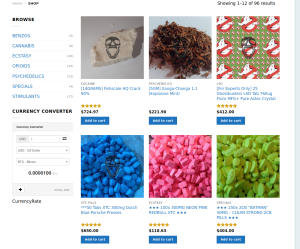
Drughub is a KING